
The Five Capacities of Viable Futures
How to Tell Whether a Future Can Hold


In my previous essay, I explored a distinction between plausible, preferable, and viable futures.
A future can be plausible without being preferable.
A future can be preferable without yet being viable.
And a future becomes viable only when it can carry life-supporting capacity through pressure and reorganization into a more stable pattern.
That raises the next question:
How can we tell whether a pathway has that capacity?
The first three essays in this series have built toward a simple point: possibility is not the same as viability. Possibility opens the field. Viability disciplines it. But if we are going to ask whether a pathway can hold, we need some way of seeing what “holding” requires.
That is the role of the five capacities.
A pathway does not become viable because it is inspiring, innovative, profitable, or preferable in principle. It becomes viable when it develops the capacities needed to function, adapt, coordinate, maintain legitimacy, and generate future possibilities as conditions change.
A pathway may be strong in one dimension and fragile in another. It may have ecological integrity, but weak financing. It may have strong community meaning, but poor coordination. It may be innovative but socially illegitimate. It may be profitable while quietly degrading the foundations on which it depends.
The five capacities I am currently working with are:
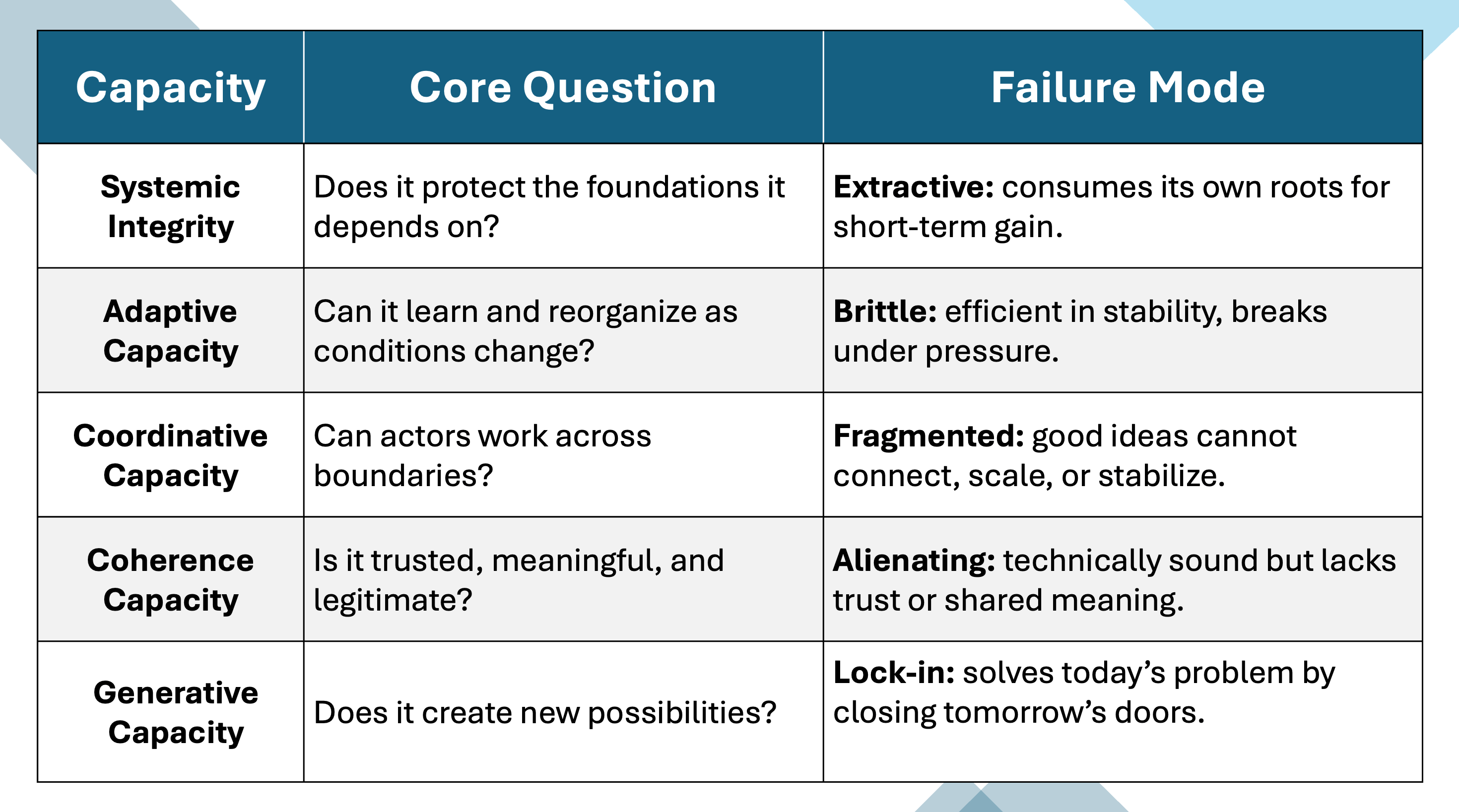
Together, these capacities help us ask a deeper question:
Can this future hold through change without consuming the conditions that make thriving possible?
The concept of viability has a long history in cybernetics and systems science, including Stafford Beer’s Viable System Model, which explored how organizations maintain the capacity to survive in changing environments. The capacities described here build on that broader tradition but extend viability beyond organizations to pathways, communities, economies, and socio-ecological systems. The question is not only whether a system can persist, but whether it preserves and regenerates the conditions that make flourishing possible.
Systemic Integrity
Systemic Integrity asks whether a pathway preserves, restores, or strengthens the foundations on which it depends.
Every system relies on underlying conditions. A food system depends on soil, water, biodiversity, farmer livelihoods, nutrition, affordability, logistics, trust, and access. A business depends on customers, workers, suppliers, institutions, infrastructure, capital, and legitimacy. A community depends on relationships, care, local capacity, ecological health, and the belief that people can build a life together.
A pathway is weak on systemic integrity when it solves one problem by degrading the foundations of another.
A food pathway may increase yield while depleting soil. A business model may increase margin while eroding customer trust. A public system may maintain service delivery by overworking its staff.
In each case, the system may still function, but it is consuming its own foundations. That is not viability.
Systemic Integrity asks: What must remain healthy for this pathway to keep working?
Adaptive Capacity
Adaptive Capacity asks whether a pathway improves the system’s ability to learn, respond, and reorganize as conditions change.
In a stable environment, efficiency can appear as a strength. But in a high-pressure environment, efficiency without adaptation becomes brittle. Systems need feedback. They need room to experiment. They need the ability to detect stress early, learn from failure, and adjust before breakdown becomes unavoidable.
Adaptive capacity is not simply resilience in the sense of bouncing back. Sometimes bouncing back is exactly the wrong goal. If the old pattern is what produced the pressure, returning to it is not adaptation. It is repetition. A viable pathway helps the system find a better fit with changed conditions.
Adaptive Capacity asks: Can this pathway learn, adjust, and reorganize without collapsing?
Coordinative Capacity
Coordinative Capacity asks whether actors can work together across boundaries.
Many systems do not fail because no one sees the problem. They fail because people and institutions cannot coordinate a response.
Information does not flow. Incentives conflict. Authority is unclear. Actors optimize locally. Trust erodes. Institutions move too slowly. The pressure crosses boundaries faster than the system can organize around it.
This is where Viable Futures extends the work opened by Possibility Chains. If Possibility Chains help us see how futures form when coordination comes under pressure, Viable Futures asks what forms of coordination could help healthier pathways hold.
In food security, localized resilience networks may sound preferable. But without processing infrastructure, procurement relationships, logistics, financing, standards, governance, and institutional support, they may remain fragmented. They may create inspiring pockets of local success without becoming a broader food system response.
The issue is not whether local is better than centralized. The issue is whether the coordination architecture fits the pressure context.
Coordinative Capacity asks: Who needs to work together for this pathway to become durable?
A future that cannot coordinate cannot hold.
Coherence Capacity
Coherence Capacity asks whether a pathway is trusted, meaningful, and legitimate.
Coordination is about aligning action. Coherence is about aligning meaning. One is the ability to move together; the other is the ability to make sense together.
A pathway can have strong technology, funding, strategy, and operational logic — and still fail because people do not trust it, understand it, see themselves in it, or believe it is legitimate.
This is especially true in systems that touch everyday life: food, health, education, work, care, mobility, climate, AI, public institutions, and community life.
A future does not become viable only because it works technically. It must also make sense.
This connects to a thread in my work around living semantics: the idea that meaning is not decorative. It is infrastructure. Shared language, narratives, symbols, and interpretations shape whether people can coordinate around change.
Without coherence, pressure becomes confusion.
With coherence, pressure can become orientation.
Coherence Capacity asks: Can people understand, trust, and find their place in this pathway?
Generative Capacity
Generative Capacity asks whether a pathway expands future possibilities rather than merely preserving current function.
This is different from adaptive capacity. Adaptation asks whether a pathway can adjust to changing conditions. Generativity asks whether that adjustment expands future possibility or merely keeps the system alive.
A pathway may work for now and still narrow the future.
It may solve an immediate problem while creating dependency. It may reduce risk while closing options. It may stabilize a system by making it less imaginative, less participatory, less adaptive, or less capable of renewal.
A viable pathway should not only get through disruption. It should leave the system more capable of future renewal.
In food security, a scarcity-management pathway may keep people fed in the short term while normalizing exclusion and dependency. By contrast, a regional food ecosystem might support farmer livelihoods, local enterprise, better nutrition, stronger community ties, soil restoration, institutional learning, and new forms of public procurement.
Generative Capacity asks: Does this pathway expand future possibilities, or does it close them down?
Generativity keeps viability from becoming mere endurance.
A viability profile, not a checklist
These five capacities are not a checklist. They are a way to build a viability profile.
A pathway may be strong in one capacity and weak in another. It may have strong systemic integrity but weak coordination. It may be technically adaptive but low in coherence. It may be generative for one group while degrading integrity for another.
Weak capacities are where adaptive traps often form. A pathway may help a system cope in the short term while degrading the capacities needed for longer-term viability.
High coordination without systemic integrity can scale extraction.
High adaptation without coherence can create constant change that people no longer trust.
High generativity without constraints can become chaotic proliferation rather than durable renewal.
That is why the point is not simply to score a pathway. The point is to see where it can hold, where it is fragile, and what must be strengthened.
This also helps explain why preferred futures often struggle. They may have moral clarity, but a weak infrastructure. Strong community meaning but weak financing. Ecological integrity but weak institutional support. Generative potential but poor coordination.
In those cases, the question is not whether the future is good enough to imagine.
The question is what capacities must be built for it to take root.
What comes next
If the five capacities help us see what can hold, the next question is what we do with that knowledge.
Assessment alone is not enough. Once a higher-viability pathway becomes visible, the work shifts from evaluation to stewardship.
How do we strengthen the conditions that allow better futures to take root? How do we support pathways without pretending we can control them? How do we act in ways that increase viability rather than simply optimize advantage within whatever future arrives?
That is where Pathway Stewardship begins. Stewardship is not about control; it is about cultivating the ground so preferred futures can actually take root. In the next essay, we look at how to move from assessment to action.
More of This Series
Article 2: What Possibility Chains Open Up
Article 3: What Makes A Future Pathway Viable?
Article 4: The Five Capacities of Viable Futures
Article 5: Pathway Stewardship
Article 6: Why Most Action Doesn’t Change the Future
Article 7: Who Decides Which Future Is Viable?
Article 8: The Resilience Trap
Article 9: The Work After Foresight
More of My Work
If you’re interested in exploring how to respond to systemic stress, not with collapse or control—but with coherence, you might also find value in:
Full Regenerative Possibility Chain Article Series: Read on Medium