
Who Decides Which Future Is Viable?
Why Better Futures Need Legitimacy


Every framework that uses the word viability eventually faces an uncomfortable question:
Viable for whom?
That question leads almost immediately to another:
Who gets to decide?
A pathway can look viable from one vantage point and harmful from another. A company may see a scalable innovation, while workers experience a loss of agency. An institution may see efficiency, while communities absorb new burdens. Investors may see returns, while ecological or social foundations quietly erode.
The pathway may be working, but only because someone else is carrying the cost.
That does not mean innovation is the problem. It means viability has to be tested from more than one perspective.
The previous essays in this series asked what makes a pathway viable, what capacities allow it to hold, what conditions help it take root, and where intervention can actually shift what becomes possible. But once we begin talking about stewardship and intervention, another question becomes unavoidable:
Who gets to decide which pathways are worth stewarding?
That question does not weaken the viability lens. It strengthens it.
It prevents viability from becoming a label applied only from the vantage point of those with the most power, capital, or authority to act. It also prevents preferred futures from escaping scrutiny simply because their intentions are good.
A pathway becomes more credible when it can be tested across vantage points: business, worker, community, institutional, ecological, and intergenerational.
Viability is always assessed from somewhere
No one sees a system from everywhere.
A corporate leader may look at a pathway and ask whether it can scale, generate returns, protect advantage, comply with regulations, satisfy customers, and be executed within operational realities. Those are real viability questions.
Corporate leaders also operate inside real constraints: investor expectations, competitive pressure, regulatory uncertainty, talent disruption, short time horizons, and the need to execute within existing operating models. Those pressures do not make narrow viability sufficient, but they do make it understandable.
A worker may ask whether the same pathway preserves dignity, agency, income, bargaining power, learning, and a meaningful role. A community may ask whether it improves access, affordability, trust, local capacity, safety, and voice. A public institution may ask whether it strengthens legitimacy, stability, accountability, and public value.
An ecological lens asks whether the pathway preserves the foundations it depends on, respects limits, reduces extraction, and renews capacity over time. Future generations cannot sit at the table, but they are still affected by the optionality, risk, debt, depletion, and dependency being passed forward.
The problem is not that any of these questions is wrong. The problem is when any one vantage point becomes the whole test.
Narrow viability is not false viability. It is incomplete.
A future is not fully viable simply because it works from the vantage point of the actor with the power to build it.
Narrow viability creates displaced burdens
This is where the concept of viability can become dangerous.
A pathway may “hold” for one group because another group absorbs the pressure. A platform may scale because workers absorb precarity. A supply chain may remain efficient despite externalized ecological costs. A city may become more climate-resilient because vulnerable residents are displaced. A technology may improve productivity by reducing human agency, trust, or judgment.
A pathway that holds for some by making life less viable for others is not a viable future. It is a displaced burden.
And displaced burdens do not disappear. They return as distrust, resistance, regulation, reputational damage, labor withdrawal, political backlash, ecological feedback, institutional instability, or loss of legitimacy.
That is why asking who decides which future is viable is not only an ethical question. It is a strategic early-warning system.
Innovation needs a wider viability test
The point is not to reject technology-forward innovation, growth, strategy, or advantage. The point is to ask what would make innovation viable across a wider field of consequence.
AI may improve service routing, scheduling, decision support, or productivity. But if those gains depend on constant worker surveillance, opaque scoring, or systems that reduce human judgment to machine compliance, the displaced burden may show up as burnout, mistrust, and lost agency.
Precision agriculture may improve yields, reduce waste, and help farmers respond to changing conditions. But if farmers become locked into proprietary platforms, data dependencies, financing arrangements, or input systems they cannot easily leave, productivity may increase while farmer agency narrows.
Climate adaptation may protect homes, infrastructure, and commercial districts. But if adaptation investments raise property values while pushing lower-income residents out, a city may become more resilient for some by becoming less viable for others.
The issue is not whether innovation is good or bad. The issue is whether the pathway strengthens viability across the system or creates advantage by shifting fragility elsewhere.
For companies, this is not anti-business. It is a more rigorous test of whether a strategy can hold in a world where social, ecological, technological, and institutional pressures are increasingly connected.
A strategy that optimizes for growth while degrading trust is not durable. A technology that increases efficiency while undermining human agency may generate both adoption and resistance. A platform that scales by capturing value from participants may eventually weaken the ecosystem it depends on.
Advantage becomes more durable when it strengthens the wider conditions that allow the system to function.
Legitimacy is a condition of viability
Legitimacy is often treated as a soft issue, something to be managed after the strategy is designed. I think that is a mistake.
Legitimacy is part of what allows a pathway to hold, especially when people are being asked to live with the consequences of decisions they did not fully shape.
People are more likely to participate in a pathway when they believe it is credible, fair, understandable, accountable, and trustworthy. They are more likely to resist, exit, or undermine a pathway when they experience it as imposed, opaque, extractive, unsafe, or misaligned with their lives.
This connects directly to my previous concept of coherence capacity. A future does not become viable only because it works technically. It must also make sense to the people expected to live inside it.
Legitimacy does not require universal agreement. But it does require enough trust, accountability, participation, and fairness for the pathway to hold under pressure.
Without legitimacy, even technically impressive pathways can become brittle. This is especially true in domains like AI, healthcare, food, education, climate, work, mobility, and public institutions. These are not merely markets. They are systems people depend on for dignity, livelihood, safety, identity, and belonging.
A wider viability test
So how do we ask “viable for whom?” without turning every future into an impossible consensus exercise?
We widen the test.
Not to demand that every pathway benefits everyone equally. Tradeoffs are real. Tensions are real. Different actors will value different outcomes. But a serious viability test should make those tradeoffs visible.
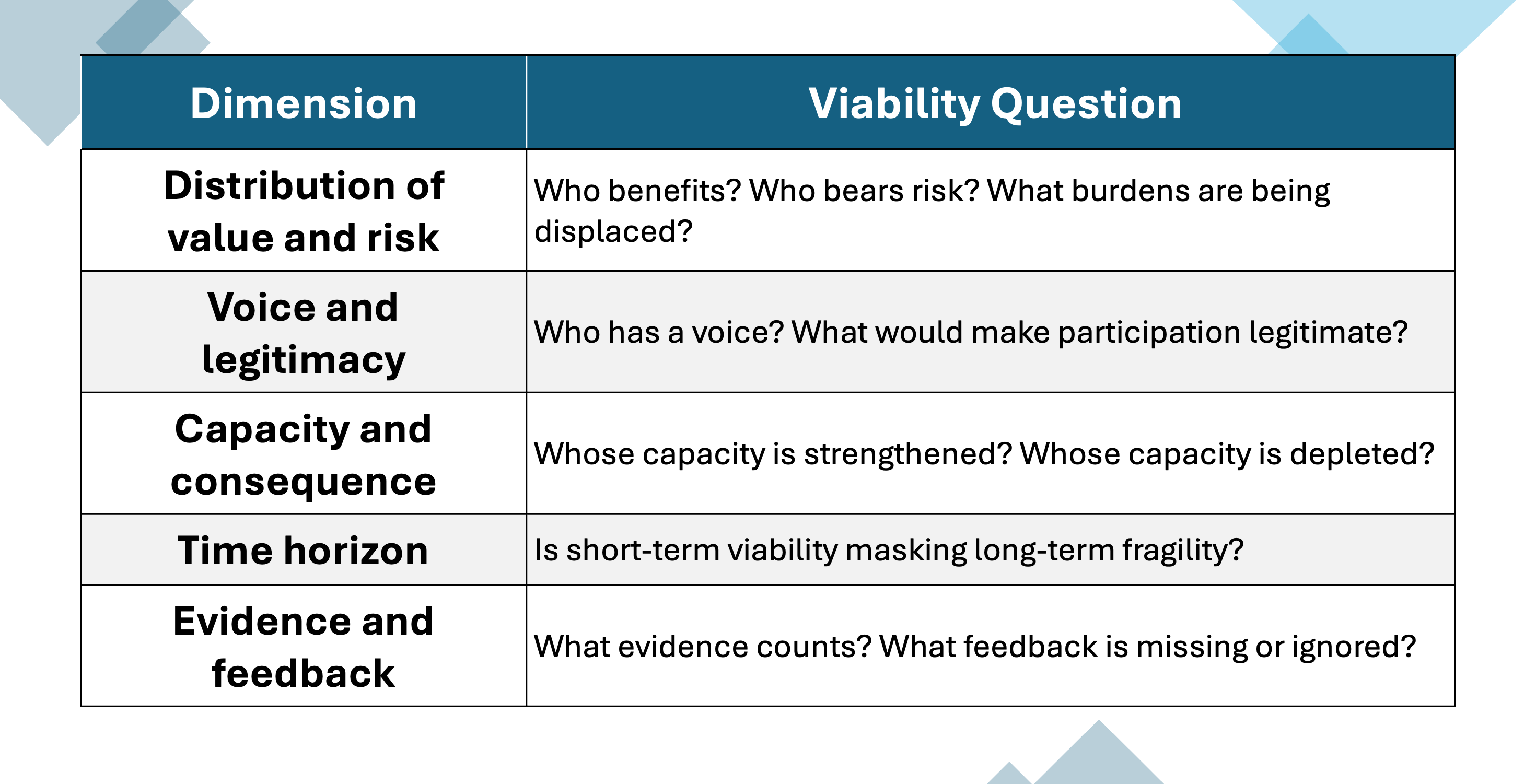
These questions make viability more honest.
They also make it more useful. A pathway that survives this wider test is more likely to be durable, trusted, adaptive, and generative. A pathway that avoids the test may still move quickly, but it may be building fragility into its own future.
The same discipline applies to preferred futures
The question “viable for whom?” also applies to people building alternatives: sustainability advocates, civic innovators, community builders, cooperative organizers, and others trying to create more life-supporting systems.
A preferred future is not viable simply because its intentions are good.
A community-led model may be meaningful but under-resourced. A local food pathway may be life-supporting but inaccessible to lower-income households. A cooperative model may strengthen the agency, but it lacks the governance capacity to scale. An initiative may speak beautifully about care, interdependence, or community while relying on unpaid labor, exhausted organizers, or relationships it does not replenish.
This is why the viability lens cannot simply be a critique of corporate futures. It must also be a discipline for pursuing preferred futures.
Good intentions do not remove the need for legitimacy, capacity, access, accountability, and real-world durability.
Viability as shared inquiry
Viability should not be treated as a verdict. It should be treated as a shared inquiry.
Not: this pathway is viable.
But: from whose vantage point does this pathway appear viable, and where might it be shifting fragility?
Not: this innovation is good or bad.
But: what would make this innovation more viable across business, community, worker, institutional, ecological, and future-facing concerns?
Not: this future is preferable.
But: what conditions would make this future legitimate, durable, and life-supporting for those who must live inside it?
This moves us away from accusation and defensiveness. It moves us toward a deeper form of design, strategy, and stewardship.
The question is no longer simply whether a future pathway works. It is whether it works by strengthening the system around it or by weakening someone else’s capacity to endure.
What comes next
This essay has argued that viability must be tested across vantage points.
A pathway can be plausible, preferable, innovative, or profitable and still fail the wider viability test if it depends on displaced burdens. That realization complicates one of the most familiar words in strategy: resilience.
Resilience is often treated as an unquestioned good. We want resilient supply chains, cities, organizations, communities, and people. But resilience is not always the same as viability.
A system can recover while preserving the very logic that made it fragile. It can protect some actors while putting pressure on others. It can bounce back without becoming more just, adaptive, legitimate, or life-supporting.
So the next question is not only whether a system can recover.
It is whether it should recover in its current form.
That is where I’ll turn next.
More of This Series
Article 2: What Possibility Chains Open Up
Article 3: What Makes A Future Pathway Viable?
Article 4: The Five Capacities of Viable Futures
Article 5: Pathway Stewardship
Article 6: Why Most Action Doesn’t Change the Future
Article 7: Who Decides Which Future Is Viable?
Article 8: The Resilience Trap
More of My Work
If you’re interested in exploring how to respond to systemic stress, not with collapse or control—but with coherence, you might also find value in:
Full Regenerative Possibility Chain Article Series: Read on Medium
Thanks David. This is a very strong and necessary argument.
Asking “viable for whom?” must be one of the most important tests any future-facing pathway must now pass in this metacrisis moment. As you coherently articulate, an emergent pathway may appear viable from the perspective of capital, scale, institutional deliverability or technical efficiency, while quietly displacing burden onto workers, communities, ecosystems or future generations.
The distinction between real viability and displaced burden is especially powerful because it prevents systemic viability from being reduced to the vantage point of the actor who has the power to build, fund or legitimise such a pathway.
Perhaps this also asks us to examine which systemic viability variables are being privileged, and which are being ignored, when a pathway is judged to be viable. In much of the current economic order, capital, scale, efficiency, productivity and institutional deliverability tend to dominate that test. But if trust, agency, legitimacy, ecological renewal and intergenerational responsibility are excluded from that test, then what appears viable may simply be a pathway that has learned how to displace its burden elsewhere.
And this for me is where the deeper shift becomes increasingly visible: from capital optimisation as the dominant test of viability, towards life-coherence as the condition through which viability can become genuinely shared.
But perhaps there is one further condition that critically deepens the argument: dignity.
For me, dignity is the “meta-value” beneath any serious account of viability. It is not simply one value amongst others, but a critical value that makes other life-serving values possible.
If we consider a world without dignity, how could we expect trust, respect, compassion, care, love, belonging, participation or responsibility to take root?
With this perspective, these values should not be regarded simply as a number of abstract moral preferences. They are instead the living conditions of the civic soil from which any meaningful collective and relational existence must grow. They only become possible when people are first recognised as beings of intrinsic worth, before they are made useful, efficient, compliant, productive, measurable or strategically relevant.
This all seems especially relevant in consideration of the examples you highlight: platform work, AI surveillance, climate adaptation, community-led alternatives and under-replenished civic labour. In each case, the displaced burden is not only economic, social or ecological. It may also be dignitary.
People can be made less viable not only by losing income, access or security, but by losing voice, agency, judgement, recognition, relational belonging, and the sense that their lives matter before any system tries to measure or justify their worth.
So perhaps we should regard dignity not just as an ethical addition to the wider viability test, but as a threshold condition. A pathway that scales by degrading dignity may still be effective, innovative, resilient or profitable in a narrow sense, but it is not life-viable in the deeper sense your essay points towards.
And that, for me, is where your argument has real force. Viability should not be treated as a strategic verdict from a dominant vantage point. It should be a shared inquiry into whether a pathway strengthens the wider conditions through which people, places and living systems can endure with agency, legitimacy and dignity.
I was looking for the connection to VSM (viable system model) - Stafford Beer...