
Why Most Action Doesn’t Change the Future
From Activity to Leverage


When systems come under pressure, action becomes urgent. Leaders launch initiatives. Communities organize responses. Institutions create programs. Companies invest in innovation. Funders look for scalable solutions. Consultants build roadmaps. Policymakers announce reforms. Some of this work matters. Some of it provides relief. Some of it buys time.
But not all action changes the future.
Some action helps people cope without changing the conditions that created the pressure. Some actions improve performance within the old logic. Some action creates the appearance of movement while the underlying pathway remains the same.
And some action, despite good intentions, actually makes the future less viable.
In my previous essay, I introduced Pathway Stewardship as the practice of strengthening the conditions that help better futures take root. Those conditions include infrastructure, coordination, trust and legitimacy, capacity, constraints, and meaning.
But once we identify which conditions are missing, we need to determine which actions actually make a difference.
The five capacities of viability help us see what is weak.
Hinge conditions help us see what must be strengthened.
Leverage points help us see where action can shift the system.
And that is where action changes what becomes possible.
The activity trap
One of the hardest things about systems under pressure is that they produce urgency.
Urgency pulls attention toward visible problems, immediate symptoms, and familiar solutions. That is understandable. People need relief. Organizations need decisions. Communities need support. Institutions need to respond.
But urgency can distort our sense of action.
More funding. More pilots. More dashboards. More partnerships. More innovation. More strategy sessions. More commitments. More communication.
All of these may be useful, but they do not all work at the same level.
A food system can receive emergency aid and still remain fragile.
A company can retrain workers while still designing work around displacement.
A city can improve disaster response while continuing to build in places that increase future risk.
A school system can add technology while preserving a model of learning that isolates students, exhausts teachers, and weakens the community.
A health system can improve access points while leaving the deeper drivers of illness untouched.
These actions may help the system cope. They may even be necessary, but they may not change the pathway.
That is the activity trap: confusing movement with leverage.
Leverage is about depth
One way to think about leverage is to look at the depth of intervention.
I am drawing here on Donella Meadows’ influential work on leverage points, especially her insight that not all interventions operate at the same depth. Some change visible resources or parameters. Others shift information flows, rules, goals, power, or the underlying mindset of a system.
In the context of Pathway Stewardship, that distinction is important because we are not only asking what action can improve performance. We are asking what action can shift the conditions that make higher-viability pathways more likely to take root.
A simple way to think about this is:
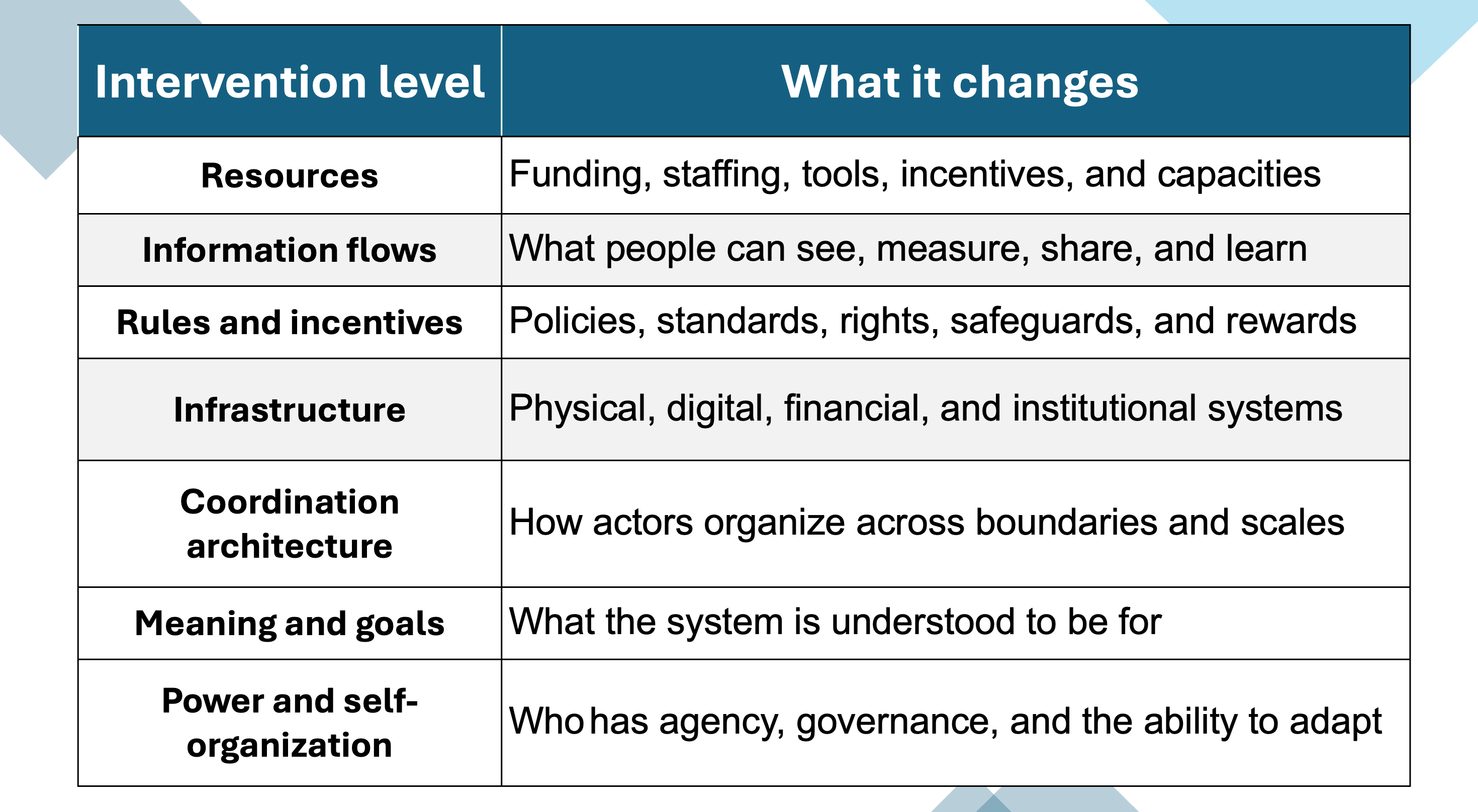
This is not a perfect hierarchy. Real systems are messier. These levels interact. A shift in rules may change incentives. New infrastructure may change coordination. A new story may change what people are willing to fund. A change in who governs may change what the system is for.
But it helps us ask:
Are we acting at the level of symptoms, or at the level of conditions?
What this looks like in practice
A resource intervention might provide more funding, staffing, tools, or technical assistance. These can be essential. But resources alone may simply help the old system keep going.
An information intervention changes what people can see. Shared data, feedback loops, transparency, dashboards, early-warning systems, and community sensing can help a system learn. But information only matters if people have the agency to respond.
A rule intervention changes what is allowed, rewarded, protected, or punished. Procurement standards, data rights, safety requirements, labor protections, land-use rules, and accountability mechanisms can make it easier to follow healthier pathways.
An infrastructure intervention changes what the system can actually carry. Food hubs, learning platforms, care networks, public procurement systems, data commons, finance vehicles, and civic institutions shape what can scale when pressure rises.
A coordination intervention changes how actors work together. Platforms, partnerships, protocols, standards, trusted intermediaries, cooperative models, commons institutions, and polycentric governance can turn scattered action into a pathway.
A meaning intervention changes what the system is understood to be for. Food can be understood as a commodity, as health, livelihood, dignity, place, and ecological relationships. AI can be understood as labor replacement or as human augmentation. Care can be understood as a private burden or as social infrastructure.
A power-and-self-organization intervention changes who has voice, agency, governance, and the ability to adapt. It asks who gets to shape the pathway as conditions change.
None of these levels stands alone. The point is not to pick one and ignore the others. It is to see that action has depth.
Some interventions manage symptoms.
Some strengthen conditions.
Some shift what the system is capable of becoming.
Food security as an example
Food security helps make the distinction concrete.
Suppose a region wants to support a higher-viability food pathway — one that strengthens farmer livelihoods, improves nutrition, increases resilience, restores ecological foundations, and serves ordinary people.
A resource intervention might provide grants or technical assistance to local producers.
An information intervention might create shared visibility into supply, demand, food insecurity, soil health, pricing, and logistics capacity.
A rule intervention might change procurement standards to enable schools, hospitals, and public agencies to buy from regional producers.
An infrastructure intervention might build regional processing, storage, cold-chain logistics, or shared distribution systems.
A coordination intervention might create a regional food council, a cooperative platform, or a trusted intermediary that connects farmers, institutions, grocers, public agencies, and communities.
A meaning intervention might reframe food not only as a commodity, but as health, livelihood, dignity, place, and ecological relationship.
A power-and-self-organization intervention might give farmers, workers, communities, and public institutions a real role in governing the pathway, not merely participating as suppliers or beneficiaries.
Each intervention matters, but they do not all work at the same depth. Funding may help a local producer survive. Procurement reform may open institutional demand. Shared infrastructure may allow regional supply to scale. A new governance model may make coordination durable. A shift in meaning may change what the public and institutions believe food systems are for.
The goal is not simply to do more. It is to act where action changes what can take root.
Acting where it matters
Leverage points are not magic buttons. They do not guarantee transformation. They do not allow us to control complex systems. And they do not remove the need for patience, iteration, feedback, and humility.
But they help us avoid confusing activity with consequence.
A system under pressure will generate demands for action. Some of that action will be necessary. Some will be symbolic. Some will stabilize the old pattern. Some will unintentionally deepen fragility. Some will open space for higher-viability pathways.
The work of Pathway Stewardship is to discern:
Where is the system stuck?
Which hinge conditions are missing?
What intervention level is most relevant?
Who has the ability to act?
What could shift the conditions rather than merely manage the symptoms?
What risks would the intervention create?
Who needs to be involved for the intervention to be legitimate?
This is where action becomes more than reaction.
It becomes stewardship.
What comes next
This essay has argued that most action does not change the future because it does not shift the conditions that shape what becomes possible.
But another question now becomes unavoidable:
Who gets to decide which futures are better?
A pathway may look viable from one vantage point and harmful from another. An intervention may strengthen capacity for some while depleting it for others. A strategy may reduce risk for one organization while shifting fragility onto communities, workers, ecosystems, or future generations.
So before we go further, the viability lens has to face its hardest question:
Viable for whom?
That is where I’ll turn next.
More of This Series
Article 2: What Possibility Chains Open Up
Article 3: What Makes A Future Pathway Viable?
Article 4: The Five Capacities of Viable Futures
Article 5: Pathway Stewardship
Article 6: Why Most Action Doesn’t Change the Future
Article 7: Who Decides Which Future Is Viable?
Article 8: The Resilience TrapMore of My Work
If you’re interested in exploring how to respond to systemic stress, not with collapse or control—but with coherence, you might also find value in:
Full Regenerative Possibility Chain Article Series: Read on Medium