
Pathway Stewardship
The Conditions That Help Better Futures Take Root


The first four essays in this series have built toward a simple claim: possibility is not the same as viability.
Possibility shows what might happen.
Viability shows what can hold.
Once we see the difference, another question follows: What do we help take root?
This is what I refer to as Pathway Stewardship.
Pathway Stewardship is the practice of strengthening the conditions that allow higher-viability futures to emerge, stabilize, and take root. Not by controlling the future. Not by forcing a preferred pathway into being. But by shaping the infrastructures, relationships, capacities, constraints, and meanings that make better futures more likely to hold through change.
That distinction matters because seeing the future is not the same as participating in it.
Much of futures work helps us prepare. That is essential. We need better ways to see what may be forming around us, especially when ecological, technological, economic, institutional, and social pressures are interacting in unpredictable ways. Possibility-oriented foresight widens perception. It helps us see that the future is not a single line extending from the present, but a field of emerging pathways shaped by pressure, constraints, incentives, capabilities, and choices.
But preparation is the beginning of the work.
Once plausible pathways become visible, we face a different kind of responsibility. Some pathways may deepen fragility. Some may preserve an advantage while shifting risk elsewhere. Some may help systems cope in the short term while narrowing future possibilities. Others may carry more life-supporting capacity, but remain underdeveloped, under-resourced, or too fragmented to take root.
That is why viability matters. It helps us ask which pathways can hold.
But even that is not enough.
A higher-viability pathway does not stabilize simply because we can see it. A better future does not take root simply because we prefer it. A regenerative or life-supporting alternative does not become durable simply because it is morally compelling.
It needs conditions.
It needs people and institutions willing to strengthen what is missing. It needs actors who understand that their choices do not determine the future alone, but they do influence which pathways become easier or harder to follow.
Pathway Stewardship begins in the space between plausibility and viability.
It does not assume we can engineer the future. Complex systems rarely respond that neatly. Outcomes emerge through interaction. Interventions create surprises. Small shifts can matter more than expected, while great efforts can disappear into the noise.
But it also rejects the idea that we are merely spectators.
We shape incentives. We build infrastructure. We allocate capital. We design platforms. We change the rules. We form partnerships. We tell stories. We build trust or erode it. We strengthen local capacity or extract from it. We create learning loops or suppress them.
These choices matter because they shape the conditions through which futures form.
The progression at the heart of this series now feels clearer to me:
Pressure reveals the break.
Possibility maps the pathways.
Viability tests what can hold.
Pathway Stewardship shapes the conditions that help better futures take root.
Pressure reveals where inherited systems are fraying. Possibility helps us see the pathways emerging from that pressure. Viability helps us distinguish what can carry life-supporting capacity through change. Stewardship asks how we participate once that difference becomes visible.
This is not a replacement for strategy. But it changes the question strategy asks.
Strategy often asks how to win within the futures that are forming.
Stewardship asks how to help better futures become more viable.
The two are not always opposed. But they are not the same.
The material of stewardship
If Pathway Stewardship is the practice, hinge conditions are its material.
Hinge conditions are the things that must be in place for a promising pathway to move from plausible or preferable to viable. They are the infrastructures, relationships, rules, capacities, constraints, and meanings that allow better futures to take root under pressure.
A simple way to read them is this:
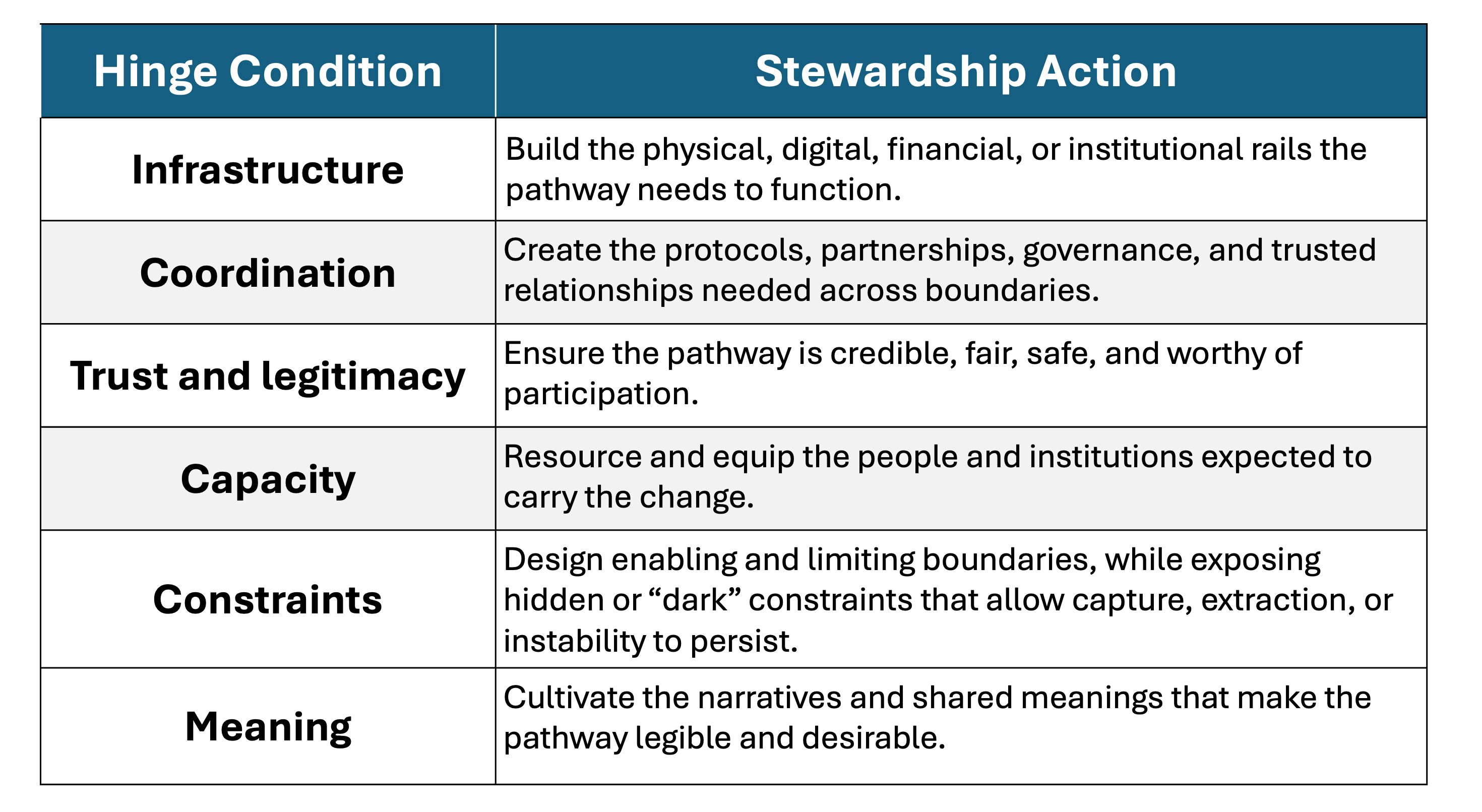
These are not abstract categories. They are the difference between a future that sounds good and one that can actually take root.
They’ve also helped me reconnect this newer framing to earlier parts of my work.
In my previous work on Regenerative Possibility Chains, I often focused on constraints, leverage points, hinge-ready infrastructure, living semantics, and regenerative literacy as points of intervention. I still see all of those as essential. But I now understand them less as separate tools and more as parts of Pathway Stewardship.
Hinge-ready infrastructure reminds us that systems reorganize around what is available when pressure creates an opening. When the hinge moment arrives, systems tend to default to the pathways with working infrastructure, financing, governance, and meaning already in place. If only brittle infrastructure is ready, brittle futures scale.
Living semantics reminds us that people do not organize around infrastructure and incentives alone; they organize around shared meanings that make new coordination legible and desirable. Regenerative literacy reminds us that people cannot steward pathways they do not know how to see. Constraints remind us that the right boundaries can protect a pathway from capture, extraction, or runaway harm — and that hidden constraints often have to be made visible before they can be changed. And leverage points remind us that some interventions shift conditions more deeply than others.
Together, these help explain how higher-viability pathways become more than ideas.
Food security as an example
Food security makes the logic tangible. The point is not to make food security the model for every domain, but to show how stewardship changes the question.
A localized or regional food pathway may be preferable. It may shorten supply chains, support local producers, create redundancy, improve nutrition, rebuild trust, and reconnect food to place.
But it is not automatically viable.
Without regional processing, cold-chain logistics, procurement relationships, financing, governance, inclusive access, farmer support, and shared meaning, it may remain fragmented or inaccessible. It may become a beautiful local pocket of possibility without becoming a broader response to the food system.
Pathway Stewardship does not romanticize the local food future.
It asks what would make it viable.
A stewarding lens would ask what infrastructure helps it function beyond isolated experiments; what coordination connects farmers, processors, schools, hospitals, grocers, public agencies, and households; what trust ensures it serves ordinary people rather than becoming a boutique alternative for the affluent; what capacities farmers, institutions, and communities need to carry the work; what constraints prevent capture or exclusion; and what meaning helps people understand food as health, livelihood, dignity, place, and ecological relationship.
The pathway becomes viable not because it is local.
It becomes viable when the conditions exist for it to coordinate, adapt, serve people, preserve foundations, and stabilize into a broader response.
That is the practical meaning of Pathway Stewardship.
From analysis to participation
There is a temptation to stop too early. We can stop at foresight and become better observers of disruption. We can stop at preference and become advocates for futures that sound better but remain underbuilt. We can stop at viability assessment and become analysts of what can hold.
But the deeper work begins when we ask what must be strengthened, protected, connected, resourced, constrained, or made meaningful for higher-viability pathways to take root.
That is the shift from assessment to stewardship.
Pathway Stewardship is not about certainty. It is about taking responsibility for the conditions we influence. Because futures do not take root simply because they are imaginable. They take root when the conditions around them become strong enough to carry them.
That is the work after viability.
And it is where this inquiry now turns.
More of This Series
Article 2: What Possibility Chains Open Up
Article 3: What Makes A Future Pathway Viable?
Article 4: The Five Capacities of Viable Futures
Article 5: Pathway Stewardship
Article 6: Why Most Action Doesn’t Change the Future
Article 7: Who Decides Which Future Is Viable?
Article 8: The Resilience Trap
More of My Work
If you’re interested in exploring how to respond to systemic stress, not with collapse or control—but with coherence, you might also find value in:
Full Regenerative Possibility Chain Article Series: Read on Medium