
I Asked AI to Explain an Article About AI
What a conversation with AI revealed about Frank Diana's "knowledge engine" and the capacities needed to absorb it.

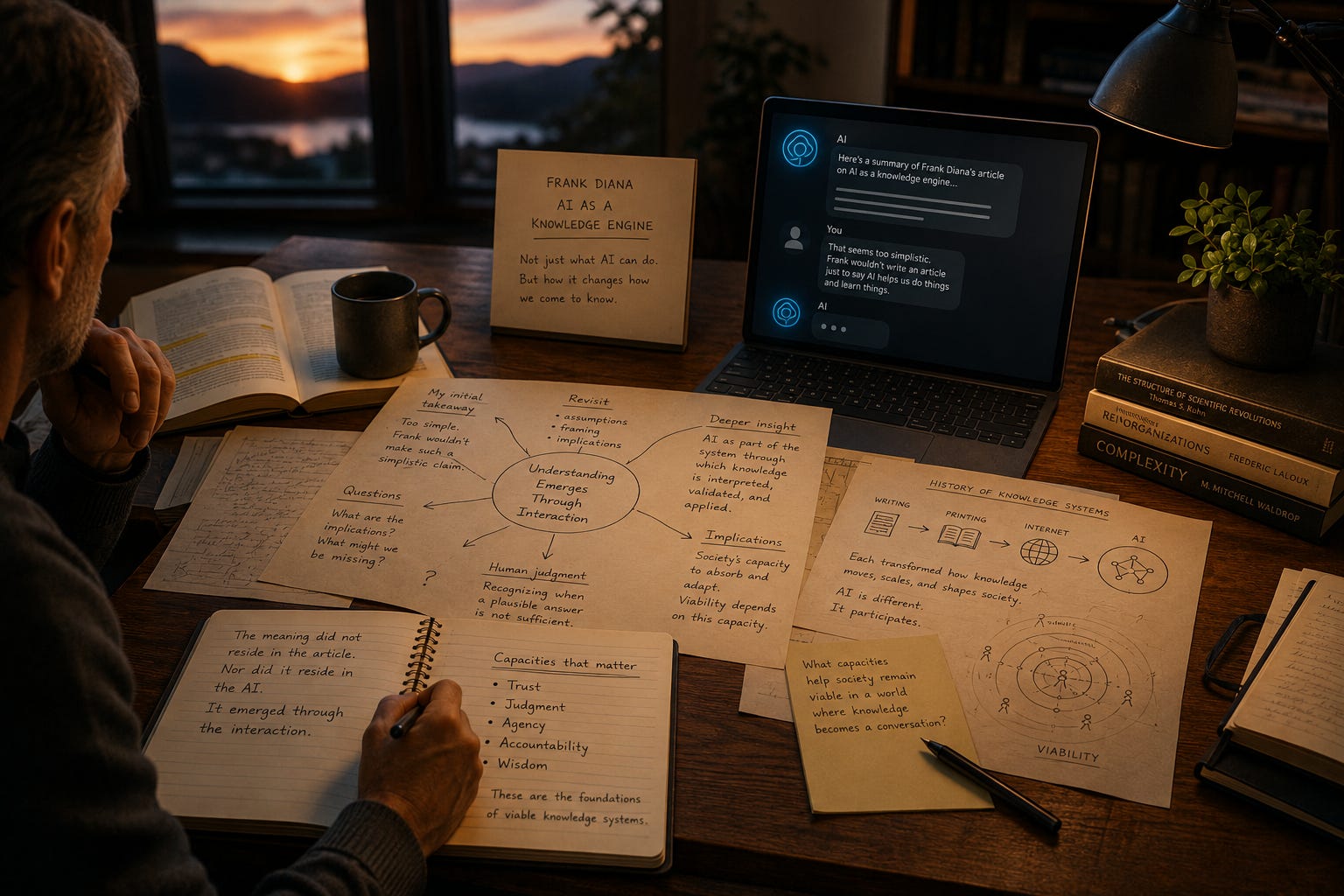
Sometimes the most important insight is not found in the article you’re reading. It’s found in the space between reading and understanding.
That happened to me recently with a piece by Frank Diana exploring whether AI is becoming a knowledge engine. I read the article, found it intriguing, and then did what many of us increasingly do: I asked AI to summarize it for me.
The response seemed reasonable enough.
Frank’s argument, the AI explained, was that AI may be two engines at once: a capability engine and a knowledge engine. A capability engine changes what we can do. A knowledge engine changes how we discover, interpret, validate, and apply what we know.
At first glance, that seemed straightforward.
Of course AI helps us do things. It writes, summarizes, analyzes, generates, translates, and automates. And of course it helps us learn things. It answers questions, surfaces information, explains concepts, and synthesizes knowledge.
But the more I thought about it, the less satisfied I was. The distinction felt too obvious.
Frank has spent years exploring systemic transitions, convergence, and the deeper implications of technological change. Surely he wasn’t writing an entire article simply to observe that AI helps us both act and learn.
I pushed back on the AI’s interpretation. We revisited the article. We examined the assumptions embedded in the summary and explored alternative readings. Gradually, a more interesting insight began to emerge.
And somewhere in that exchange, I realized I was participating in the very phenomenon Frank was describing.
What struck me was that the article itself was no longer the endpoint of the learning process. It had become the starting point for a dialogue. Frank had introduced an idea, but understanding that idea required conversation. Not simply with the author, but with an AI system capable of offering interpretations, reframing arguments, and exposing assumptions. The insight did not arrive fully formed when I finished reading. It emerged through interaction.
The irony was hard to miss. I was trying to understand an argument about AI becoming part of our knowledge systems by engaging with AI as part of my own knowledge system.
But something even more interesting was happening. The meaning did not reside in the article alone. Nor did it reside in the AI. It emerged through the interaction. At the same time, the breakthrough did not come from the AI simply producing a better answer. It came from recognizing that the first answer was incomplete.
The AI provided a plausible interpretation. I brought context, skepticism, and an intuition that something important was missing. The deeper understanding emerged from the interaction between machine synthesis and human judgment.
The issue was never whether AI helps generate knowledge. The issue was whether AI is becoming part of the system through which knowledge itself is interpreted, validated, and applied. That realization made me return to Frank’s article with fresh eyes.
Perhaps the point is not that AI helps us access knowledge. We already have books, teachers, libraries, search engines, and the internet for that. Perhaps the deeper shift is that AI is increasingly becoming part of the process through which knowledge is interpreted, refined, challenged, and applied. In that sense, AI is becoming more than a tool for accessing knowledge. It is becoming part of the knowledge system itself.
That distinction may sound subtle, but history suggests such shifts are important.
The most transformative technologies have changed more than what people could do. They have changed how societies organize around knowledge. Writing allowed knowledge to persist beyond individual memory. Printing dramatically expanded who could access it. The internet accelerated its global distribution. Each transformation altered not only what people knew, but how knowledge moved through society and how societies made sense of the world.
AI is often compared to electricity because electricity transformed nearly every aspect of modern life. It powered factories, communications, transportation, medicine, and cities. But electricity powered machines. It did not participate in reasoning, interpretation, discovery, or sense-making. That is what makes AI different. It is not simply extending our capabilities. It is increasingly participating in the processes through which understanding itself emerges.
When a student uses AI to explore an idea, when a researcher uses it to identify patterns, when a strategist uses it to test assumptions, or when someone like me uses it to unpack a complex argument, AI is no longer sitting outside the learning process. It is becoming part of it.
Increasingly, the path from question to understanding includes an AI somewhere along the way.
If that is true, then the challenge before us is not simply technological. It is societal.
History offers some useful perspective. The printing press dramatically expanded access to knowledge, but it also accelerated propaganda, conflict, and institutional upheaval. The internet connected humanity at unprecedented scale while simultaneously fragmenting attention, amplifying misinformation, and challenging our ability to maintain a shared understanding of reality. Every major advance in humanity’s ability to generate and distribute knowledge has created a corresponding challenge of adaptation. New capabilities emerge, but societies must learn how to absorb them.
AI is unlikely to be an exception.
The question is not whether AI can generate more information, more analysis, or more insight. It clearly can. The question is whether people, institutions, and societies can maintain the qualities that make knowledge useful in the first place.
Trust.
Judgment.
Agency.
Accountability.
Wisdom.
These capacities become more important, not less, as knowledge becomes more abundant and more machine-mediated. So too does the ability to distinguish signal from noise, to question an answer rather than simply accept it, and to coordinate around a shared understanding of reality while still allowing for disagreement and diverse perspectives.
In many ways, my conversation about Frank’s article demonstrated exactly this dynamic. The breakthrough occurred when human judgment refused to mistake a plausible answer for a sufficient one. Had I simply accepted the initial summary, I would have missed the deeper insight entirely.
What ultimately created value was not the answer itself, but the process of questioning it. The conversation became a cycle of challenge, refinement, and reflection through which understanding gradually emerged.
The insight was not delivered.
It was developed.
That experience left me wondering whether one of the most important capacities of the coming decade will be the ability to engage intelligently with intelligence itself. Not merely to access information or consume answers, but to participate in a richer process of inquiry. To ask better questions. To challenge assumptions. To test interpretations. To bring context, judgment, and lived experience into the conversation.
This is where my thoughts returned to the question of viability.
Much of my recent work on Viable Futures has explored what enables futures, systems, and societies to remain viable amid increasing pressure and change. From that perspective, the challenge posed by AI is not whether the technology works. It is a question of whether our social, cultural, and institutional capacities evolve quickly enough to absorb what technology makes possible.
In many ways, what Frank describes as the human capacity to absorb change is closely related to what I have been exploring through the lens of viability. Both point to the same challenge: whether people, institutions, and societies can adapt without losing the qualities that allow them to function, coordinate, and flourish.
Can we maintain trust as synthetic content proliferates?
Can we adapt our institutions as expertise becomes increasingly AI-mediated?
Can we coordinate around shared understanding while personalized intelligence becomes ubiquitous?
Can we preserve human agency, judgment, and meaning in environments saturated with machine-generated insight?
These are not primarily technical questions. They are questions about a society’s capacity to remain coherent, adaptive, coordinated, and generative as the conditions of knowledge change.
Frank’s article asks whether AI is becoming a knowledge engine.
The question I am left with is what capacities we must strengthen if we are to absorb that engine successfully.
Because the future may depend less on whether AI becomes more intelligent and more on whether we become capable of living wisely with that intelligence.
Perhaps the most important challenge is not building the engine.
It is learning how to remain viable in a world shaped by it.
My Viable Futures Series
Article 2: What Possibility Chains Open Up
Article 3: What Makes A Future Pathway Viable?
Article 4: The Five Capacities of Viable Futures
Article 5: Pathway Stewardship
Article 6: Why Most Action Doesn’t Change the Future
Article 7: Who Decides Which Future Is Viable?
Article 8: The Resilience Trap
More of My Work
If you’re interested in exploring how to respond to systemic stress, not with collapse or control—but with coherence, you might also find value in:
Full Regenerative Possibility Chain Article Series: Read on Medium