
When Everyday Life Becomes a Threshold
A Regenerative Reflection on Frank Diana’s “Why Everything Feels Like It’s Changing At Once”

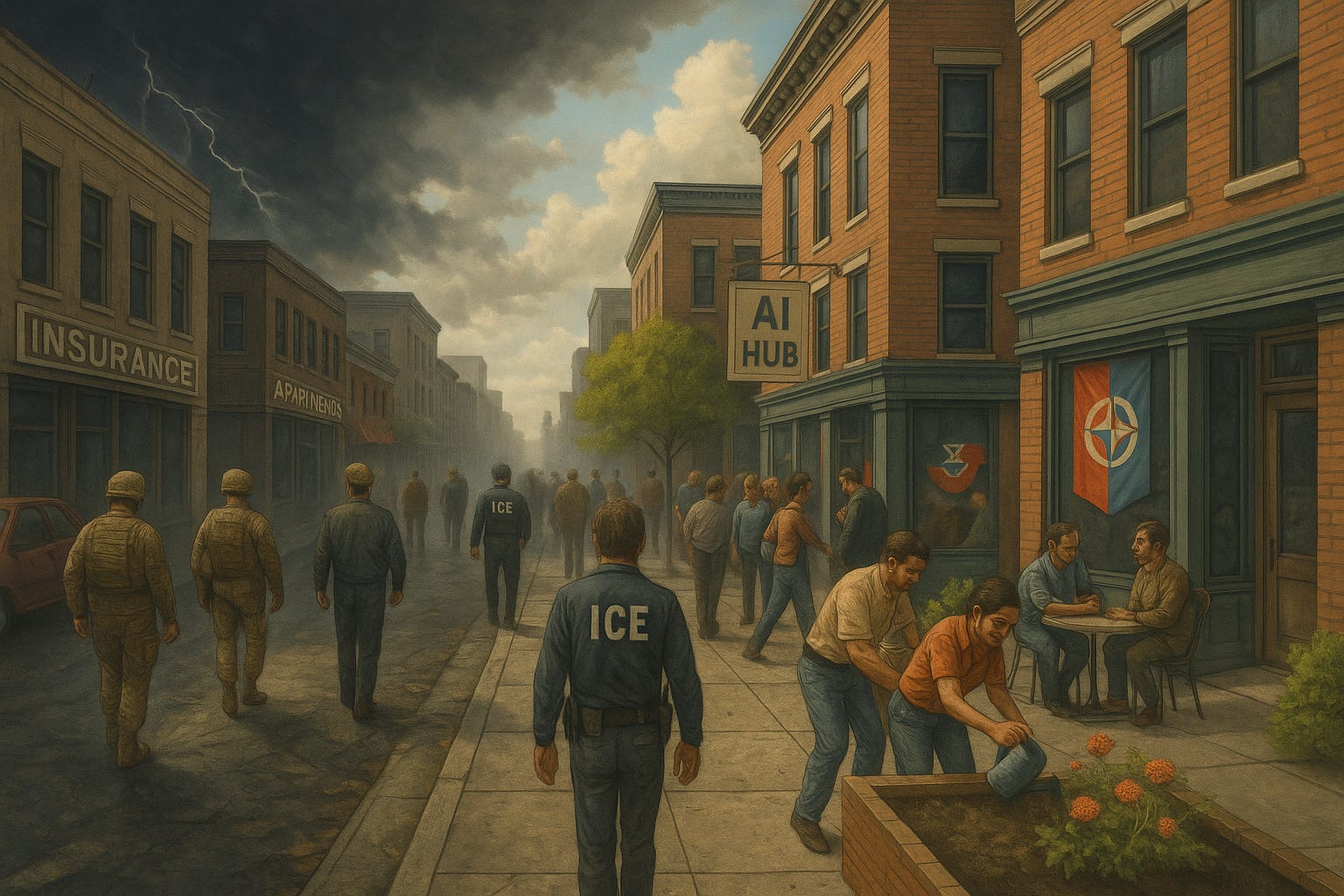
Main Street, 2025
Walk down Main Street today, and the change is unmistakable.
A store that survived three recessions just closed — wildfire risk made insurance costly for the owner to renew.
Across from it, a row of apartments sits dark: bought by investors, priced beyond reach for the teachers and nurses who once lived there.
Down the block, a payroll platform has gone “AI-first” — half the staff let go, one person now overseeing tools that do the work a roomful once did.
Immigration enforcement has returned — unannounced visits, worried glances at the door. People text loved ones before leaving home: “Are you good today?”
Heavily armed police units appear at protests — not for disaster response, but to manage civic tension.
Political banners fill windows that once held children’s art — neighbors signaling affiliation like battle lines on a map.
It reminds us: the tension is no longer distant. It’s local.
Climate strain.
Affordability collapse.
AI in every doorway.
Democracy under stress.
Belonging contested at the street level.
Same place. Same people. But the ground beneath them is reorganizing. For some, it feels like everything stable is slipping away. For others, that everything stuck might finally loosen.
Both are true.
Main Street has become a fault line, and a testing ground for whatever comes next.
Compression Has a Texture — and It’s Getting Coarser
In the second post of his current series, Frank Diana gives language to the tension we feel. He calls it compression — the sensation of everything becoming heavier, tighter, more reactive, and harder to predict.
And what we’re experiencing now is no longer subtle. Pressure is beginning to crack at the edges. Routines aren’t holding. Systems lag reality. Simple tasks take more energy than before. Institutions strain under the weight they were never designed to carry.
We may still be inside compression, but the edges of instability are now visible—close enough to feel, and no longer ignorable.
Same Street, Split Realities
Two neighbors see the same closed store. One fears the loss of stability — a signal that something important needs to be protected. Another feels hope, a chance to build something better. Same event. Different histories with this place. Different meanings.
Those who were held by the old system fear its erosion. Those who were harmed by it feel its release. Fear isn’t the opposite of progress — it’s an indicator of what must be honored. Hope isn’t naïve — it’s an indicator of what must be allowed.
This divergence isn’t dysfunction. It’s a map. It shows us where the old pattern once provided real security — and where it failed too many for too long. It shows us where care is needed — and where emergence is already underway.
A threshold moment isn’t a showdown between those who fear and those who hope — it’s the work of helping both contribute to what comes next.
Regeneration Has Already Begun — Quietly, Locally
Even as Main Street strains, life is reorganizing. Where things are breaking, something is already trying to fix itself.
Where wildfire risk makes insurance vanish — neighbors are banding together to harden homes, removing fuel zones, and testing local risk-sharing and micro-insurance models that keep each other covered when companies won’t.
Where investor-owned apartments sit dark, residents are buying land back through community land trusts and cooperatives, putting homes into community stewardship instead of distant portfolios.
Where automation removes livelihoods, emerging worker-owned platforms, micro-enterprises, and community AI labs are helping people build value for each other, not just for shareholders.
Where fear reshapes daily routines — mutual-aid networks ensure people don’t navigate uncertainty alone, turning neighbors into informal safety nets.
Where authority escalates with armor — community responders, crisis teams, and civic mediation hubs are de-escalating with care, support, and relationship instead of force.
Where politics divides neighbors — participatory budgeting, citizen assemblies, and independent local media are rebuilding trust through shared decisions and shared stories.
These aren’t patches. They’re prototypes. They are small, grounded, relational experiments — early attractors of a new pattern of life.
Main Street isn’t just breaking.
It’s breaking open.
What Compression Is Actually Revealing
Frank says compression tightens the system. From a regenerative lens, compression reveals the limits of the current pattern — where life can no longer be held by the structures we’ve built.
It shows us that:
Institutions can’t keep pace
Narratives no longer match our lives
Infrastructure isn’t serving what communities need
In the gap between what is and what’s possible, compression exposes a deeper truth:
It isn’t just pressure. It’s longing.
Longing for meaning.
Longing for belonging.
Longing for coherence — a life that actually fits how people want to live.
That longing is not a flaw. It’s a signal—a clue that reorganization is already underway.
History reminds us: compression doesn’t guarantee renewal. It can lead to fracture just as easily. But if we strengthen connection before the turn — then reordering can become design space: not collapse, but the possibility of renewal.
Closing — This Turn Is Not Passive
Frank reminds us: compression signals readiness, not failure. A world that no longer fits itself is a world seeking a new shape.
My role in this dialogue is to explore how that new shape could emerge:
strengthen belonging and reciprocity
nurture early attractors of renewal
prepare the spaces where new patterns can settle
cultivate the relational capacity to hold strain
We don’t choose when the threshold arrives. But we choose how we walk through it.
And right now?
Main Street — the real one, the messy one, the contested one — is where the future is already emerging. Our work is to notice, participate, and respond with connection, resilience, and possibility.
More on Regenerative Futures
If you’re interested in exploring how to respond to systemic stress, not with collapse or control—but with coherence, you might also find value in:
Full Regenerative Possibility Chain Article Series: Read on Medium